
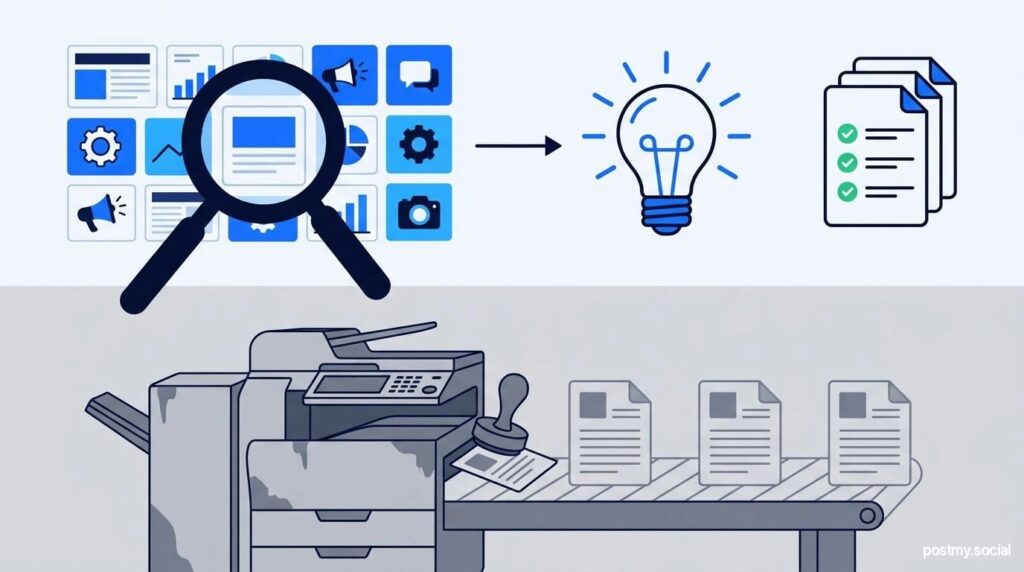
If you have ever sat down to write a blog article, opened three competitor websites "just for inspiration" and come away with something that reads suspiciously like a rewritten version of their best page, you are not alone. Competitor research is one of the most useful habits in marketing, and also one of the easiest to get wrong. Done well, it tells you what questions your shared customers are actually asking, where competitors are weak, and where there is room to say something more useful. Done badly, it quietly turns your content into a slightly reworded copy of someone else's, which helps nobody: not your readers, not your search visibility, and not your own credibility.
This article is about drawing that line clearly. We will look at what useful competitor research actually involves, how imitation creeps in without anyone intending it, the practical and legal reasons to avoid it, and a repeatable process for turning "what are they doing" into "what should we do" without ever opening a competitor's page in one tab and your own draft in the other.
Key takeaways
- Useful competitor research asks why something works for a customer, not just what a competitor published.
- Copying wording, structure or layout crosses into imitation even without copying ideas or facts, and can create real copyright and trade mark risk.
- A simple test: if you cannot recreate your point without checking a competitor's page while drafting, you have borrowed their expression of the idea rather than understood it.
- Looking at businesses outside your direct category reduces the temptation to copy and often surfaces better format ideas.
- The most valuable output of competitor research is usually the question competitors answer badly or not at all, not their best page.
Why competitor research matters, and why it goes wrong
Nobody sets out to copy a competitor. It usually happens gradually. You open their blog to see what they are covering, you read a paragraph that explains something well, and without quite meaning to, your own draft ends up following the same structure, making the same points in the same order, sometimes with suspiciously similar phrasing. This is not dishonesty so much as cognitive anchoring: once you have read someone else's answer to a question, it is hard to un-read it and arrive at a genuinely independent one.
The irony is that competitor research is genuinely valuable when done properly. It shows you which topics matter to your shared audience, which formats they respond to, where pricing and positioning sit in your market, and critically, where competitors are leaving customer questions unanswered or answered poorly. That last point is usually the most useful outcome of any competitor review, and it is the one most businesses skip because it requires more thinking than simply noting what already exists.
The difference between research and imitation
Useful research asks why something exists. Imitation asks what to copy. If you read a competitor's pricing page and think 'they explain their refund policy clearly, I should explain mine clearly too', that is research. If you think 'I should structure my refund section exactly like theirs, with the same three headings in the same order', that is drifting towards imitation, even without copying a single word.
A practical test: after reviewing a competitor's content, close the tab, wait a few minutes, and write your own version from memory and your own knowledge rather than referring back to their page while drafting. If you cannot recreate your point without checking their wording, you probably have not internalised the idea, you have borrowed their expression of it. The underlying facts, data and genuinely useful information in your industry are shared territory. The specific words, structure, examples and creative choices used to present them are not.
The legal and practical reasons it matters
Setting ethics aside for a moment, there are concrete reasons to keep a clean line between research and imitation. Copyright protects the specific expression of an idea, meaning the actual sentences, images, video and distinctive layout a business has produced, not the underlying facts or general approach. Lifting a competitor's wording, even with light rewording, can expose a business to a legitimate complaint, and search engines have also become reasonably good at detecting content that closely mirrors existing pages, which does nothing for your own search visibility.
There is also a quieter cost that is easy to underestimate: imitation makes your content forgettable. If three businesses in the same industry publish near-identical advice because they all researched each other, a reader who checks more than one site notices immediately, and your business looks like the follower rather than the authority. The businesses that earn repeat readers and referrals are usually the ones willing to say something slightly different, even in a crowded topic area.
A practical process for clean competitor research
Start by defining the question you are actually trying to answer before you open a single competitor site. If you already know what your article or page needs to cover from your own expertise, use competitor research to check for gaps and sense-check tone, not to generate the structure from scratch.
When you do review competitor content, take notes as questions and observations rather than copied text. Instead of pasting a paragraph into a notes document, write something like 'they explain shipping costs upfront on the product page, we currently bury this in the FAQ' or 'none of the three competitors I checked explain what happens if a customer misses a renewal date, that seems like a genuine gap'. Notes written as observations are far harder to accidentally plagiarise than notes written as copied passages, because you have already done the work of translating the finding into your own language.
Then look specifically for what is missing, not just what is present. A competitor's best-performing page tells you a topic matters. It does not tell you their answer was complete. Read it the way a sceptical customer would: what question would you still have after reading this? That unanswered question is usually a better starting point for your own content than reproducing what they already covered well.
Finally, write your draft away from the competitor tabs entirely. Use your own examples, your own customer conversations, your own numbers where you have them, and your own voice. If you need to double-check a specific fact later, that is fine, but drafting from your own head rather than from an open competitor page is the single most effective habit for staying on the right side of the research-versus-imitation line.
Widening the research beyond direct competitors
One underused technique is looking slightly outside your own category. A regional accounting firm can learn a great deal from how a well-regarded law firm or financial adviser explains complicated concepts in plain English, without being anywhere near a direct competitor. This has two advantages: it reduces the temptation to copy, because the content is not literally about the same products or services, and it often surfaces better ideas, because businesses outside your immediate market have solved similar communication problems in ways your direct competitors have not thought to try.
It is also worth occasionally researching businesses you consider genuinely excellent at explaining things, even in unrelated industries, purely for structure and clarity, never for specific claims or wording. Noticing that a particular business always opens its guides with a real customer scenario, or always ends with a short checklist, is a transferable format observation, not a copied idea, provided you build your own version rather than reusing their actual content.
What this looks like for ongoing content planning
If competitor research is a one-off exercise before a single article, it tends to produce one round of good ideas and then nothing. Treated as an ongoing habit, reviewed monthly or quarterly rather than article by article, it becomes a genuinely useful input alongside your own customer questions, search data and industry knowledge. The goal is never to match what competitors publish. It is to understand the landscape well enough that your own content decisions are informed rather than guessed at, while the actual words on your page remain entirely your own.
Frequently asked questions
Is it illegal to copy a competitor's content?
Copying another business's exact words, images or distinctive creative work can breach copyright law, and copying a slogan, name or distinctive branding closely enough to confuse customers can raise trade mark or passing-off issues. Ideas, formats and general approaches (a how-to guide, a comparison table, a Tuesday email newsletter) are not usually protectable in themselves. The safest practical rule is: never copy wording, images or structure, but feel free to notice that a format works and build your own original version of it.
How many competitors should I actually research?
For most small and medium businesses, three to six close competitors plus two or three adjacent or aspirational businesses outside your immediate category gives a useful spread. Watching dozens of competitors tends to produce noise rather than insight, and it quietly nudges your content towards an average of what everyone else is already doing.
What is the difference between competitor research and competitive intelligence?
In practice they are often used interchangeably, but competitor research usually means directly observing what competitors publish, price and say. Competitive intelligence is the broader discipline of combining that observation with customer feedback, search data, industry trends and your own performance data to make strategic decisions. Research is one input into intelligence, not the whole picture.
Should I ever use a competitor's exact keywords?
Yes, within reason. Keywords and search terms are not owned by anyone, and if a competitor ranks for a phrase your shared customers clearly search for, there is nothing wrong with writing your own, better answer to that query. The line is crossed when you copy their actual page content, headings or phrasing rather than independently answering the same question.