
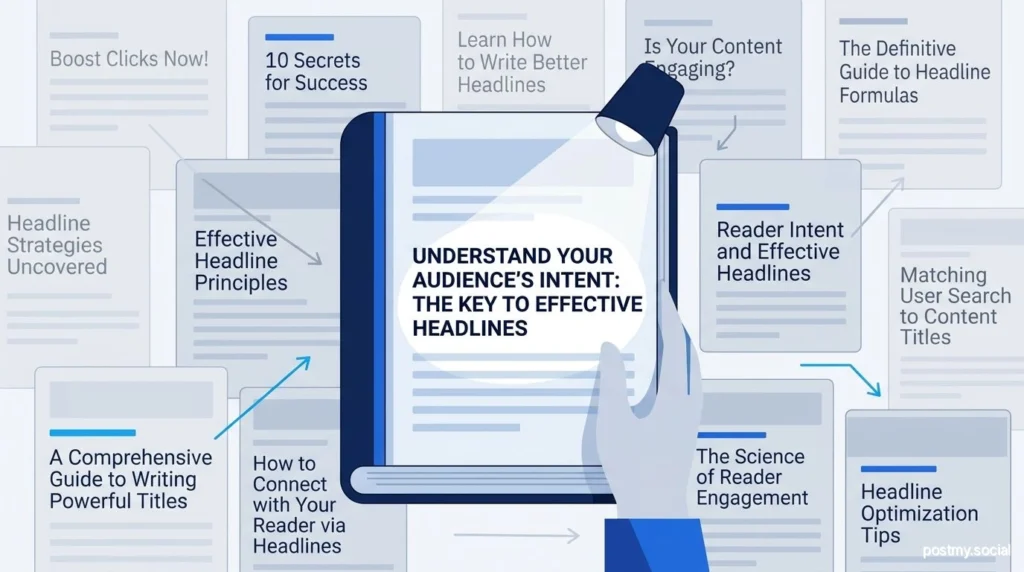
You've written a genuinely useful article, then spent ten minutes staring at the headline field wondering why nothing sounds right. This happens because headline writing isn't really a wording problem. It's an intent-matching problem. The best headline isn't the cleverest one, it's the one that tells the right reader, accurately, what they're about to get. Get that wrong and you either attract the wrong audience (who bounce immediately) or undersell the right one (who never click at all). This article walks through how to work out what a reader actually wants when they search or click, and how to build a headline around that rather than around what sounds impressive.
Key takeaways
- Reader intent usually falls into one of a few buckets: learning, comparing, deciding, fixing a problem or getting inspired. Your headline should signal which one you're serving.
- A headline makes a promise. The article has to deliver on that exact promise, not a looser version of it.
- Specific headlines (numbers, named outcomes, named problems) usually outperform vague or clever ones because they reduce guesswork for the reader.
- Mismatched headlines increase bounce rates and erode trust, even if they technically get more clicks.
- Testing headline variants against the same article is more useful than agonising over one perfect version before publishing.
- Search intent and headline intent are not always the same thing. Check what's actually ranking for a query before assuming what readers want.
Start with the question the reader is actually asking
Before you write a headline, write down the question in the reader's head. Not the topic, the question. "Content calendars" is a topic. "Why does my content calendar fall apart after two weeks?" is a question. Headlines that answer topics tend to be vague. Headlines that answer questions tend to be useful.
A simple way to find the real question is to look at how people phrase searches, forum posts or client emails about the subject. They rarely ask in polished sentences. They ask things like "why isn't this working" or "what's the difference between X and Y" or "is it worth doing this myself". Your headline should sound closer to that phrasing than to a textbook chapter title.
If you're working from a keyword, don't just insert it into a generic template. Ask what someone typing that phrase is actually trying to achieve right now. Someone searching "best blog posting frequency" might want a number, a rule of thumb, or reassurance that their current schedule is fine. Those are three different articles, and three different headlines.
Match the headline to the type of intent, not just the topic
Most reader intent falls into a handful of patterns, and each one suits a different headline style.
Informational intent means the reader wants to understand something. "How to choose an article headline that matches reader intent" (the one you're reading now) is informational: it promises a method, not a product or opinion.
Comparative intent means the reader is weighing options. Headlines here work best when they name the things being compared: "Blog-first vs social-first content strategies" tells the reader exactly what trade-off they're about to read about.
Problem-solving intent means something is broken and the reader wants it fixed. These headlines benefit from naming the problem plainly: "Why your headlines get clicks but no reads" is more useful than "Headline mistakes to avoid" because it names a specific, recognisable symptom.
Decision intent means the reader is close to acting and wants confidence, not more theory. These headlines tend to be shorter and more directive: "Should you publish daily or weekly?" works because it's a yes/no framing the reader can resolve quickly.
Once you know which bucket your article sits in, the headline almost writes itself, because the job of the headline is simply to signal that bucket honestly.
- Informational: explain a concept or process clearly
- Comparative: name both (or all) options being weighed
- Problem-solving: name the specific symptom, not just the general topic
- Decision: frame it as something that can be resolved, not just explored
Make a promise you can actually keep
A headline is a contract. If it says "7 ways to", there need to be seven distinct, useful ways in the article, not three padded out with filler. If it says "the complete guide", it needs to actually be complete, not a 400-word skim. Readers notice the gap between promise and delivery almost immediately, usually within the first two paragraphs, and they leave when they spot it.
This matters more than it sounds, because mismatched headlines don't just lose that one reader. They teach search engines and platforms that people bounce off your content, which can quietly work against you over time. It's far better to under-promise slightly and over-deliver than the reverse.
A useful check before publishing: read only the headline, then read only the introduction. Do they describe the same article? If the headline says "mistakes to avoid" but the introduction starts explaining a process instead, one of them needs to change.
Be specific instead of being clever
Clever headlines are fun to write and usually underperform specific ones. "The headline that changed everything" is vague and could mean almost anything. "How to choose a headline that matches reader intent" tells the reader exactly what they'll learn and whether it's relevant to them. Specificity does the filtering for you: the right readers self-select in, and you don't waste a clever line on people who were never going to read the article anyway.
Specificity usually comes from one of a few ingredients: a number ("5 questions to ask before…"), a named outcome ("…that gets replies" rather than "…that works"), a named audience ("for small business owners" rather than nothing), or a named problem ("when your open rate drops" rather than "email tips"). You don't need all four in one headline, but one or two usually lifts a vague headline into a useful one.
Worked example: compare "Improving your email marketing" with "Why your welcome emails get ignored (and what to send instead)". The second version names the specific moment (welcome emails), the specific problem (being ignored) and implies a specific fix. It's longer, but it's not padded. Every word is doing a job.
Check what's already ranking before you decide
If you're writing for search, look at what currently ranks for the phrase you're targeting before finalising your headline. This isn't about copying; it's about understanding what Google and searchers currently believe the intent to be. If every result for a phrase is a listicle, a single long-form guide might still work, but a single opinion piece probably won't, because it doesn't match what searchers have learned to expect from that query.
Google's own guidance on search quality emphasises content that genuinely serves the searcher's need rather than content built primarily to match a keyword phrase (Google Search Central, source-2). That's a useful discipline for headlines too: write the headline for the human decision happening in that moment, and let the keyword sit naturally inside that decision rather than forcing it in at the expense of clarity.
If you're unsure whether your article matches intent, a quick test is to imagine three different people clicking the same headline. Would all three get what they expected? If one of them would feel misled, the headline is probably trying to serve two different intents at once, and it should probably become two articles instead of one headline stretched too far.
Sources: Documentation to Improve SEO | Google Search Central | Google for Developers
Write several versions before you settle
Most experienced writers don't land on the final headline first. They write the article, then draft five or six headline options and read each one cold, as if encountering the article for the first time. This distance helps you spot the difference between a headline that sounds good to the person who already knows the content, and one that actually communicates clearly to someone who doesn't.
A practical approach: write one headline for each intent type (informational, comparative, problem-solving, decision), even if you're confident which one fits. Sometimes the exercise reveals that your article is actually answering a decision question when you'd framed it as informational, which changes the whole headline and sometimes tightens the article itself.
If you're publishing across a blog and other channels, it's worth noting that a headline that works for a search-engine reader (specific, keyword-led) isn't always the same headline that works as a standalone social hook (more conversational, often framed as a question or observation). That's a separate adaptation job, not a sign the original headline was wrong.
Frequently asked questions
Should a headline include the exact keyword I'm targeting?
It helps, particularly for search-led articles, but only if it reads naturally. A headline that reads like a forced keyword insertion signals low effort to both readers and search engines. If the exact phrase is awkward, a close natural variation that preserves the same meaning usually performs just as well.
Is it ever okay to use a curiosity-gap headline?
Occasionally, but it's risky for educational content. Curiosity gaps work when the reveal is genuinely satisfying and closely tied to the topic. For how-to and problem-solving content, readers generally respond better to clarity than mystery, because they're looking for a specific answer, not entertainment.
How long should an article headline be?
Long enough to be specific, short enough to be read in one glance. There's no fixed word count that works everywhere, but if you can't say what the article is about within roughly ten to twelve words, it's often a sign the article itself is trying to cover too much.
What's the difference between search intent and headline intent?
Search intent is what someone wants when they type a query. Headline intent is the promise your specific headline makes about your specific article. They should align, but it's worth checking separately: you can write a headline that technically matches the keyword while still misrepresenting what your article actually delivers.
Related resources