
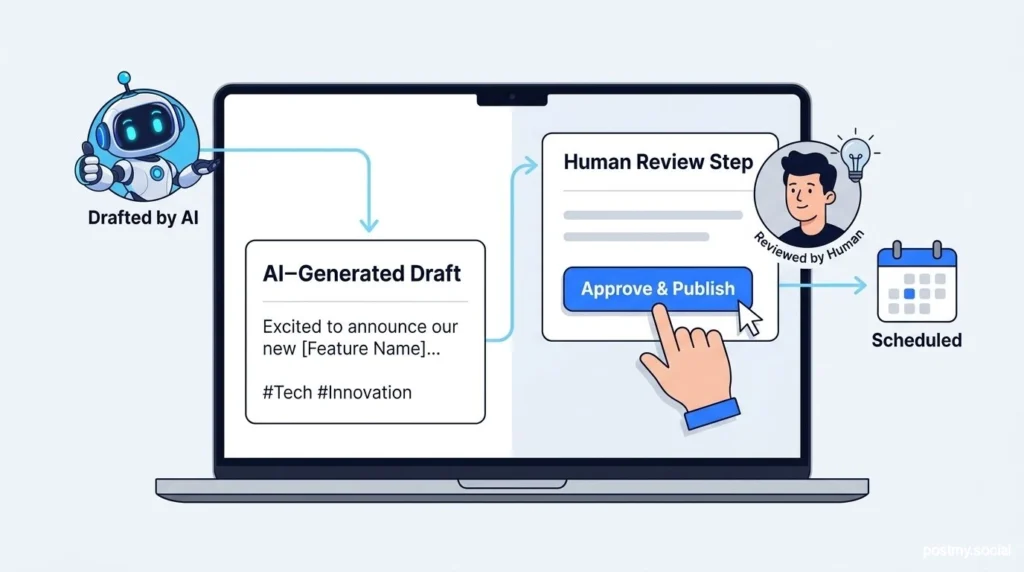
AI can draft a social caption in seconds, but speed is not the same as judgement. A caption that reads well in isolation can still miss a client's tone, misstate an offer, or use a word the brand has asked everyone to avoid. That gap between a fast draft and a safe, accurate post is exactly why PostMy.Social supports a review step for article and social packages in its assisted workflow. This article walks through how that review step works in practice, using a simple example of an agency checking a client's social caption before it goes live, and explains what the current Brand Brain, drafting and publishing workflow actually does today.
Key takeaways
- In assisted mode, PostMy.Social drafts articles and social content from an approved Brand Brain and holds them for human approval. Autopilot requires explicit enablement and follows the approved publishing rules.
- A simple agency example shows how a draft caption is checked against brand voice, facts and offers before it goes live.
- Connected publishing to WordPress, Facebook, Instagram, Threads and X is a live capability, but each destination depends on its own connection and permissions.
- Analytics and automatic evergreen recycling are still developing, so review currently relies on human judgement rather than automated performance signals.
- The workflow is designed to keep agencies and business owners in control of what goes out under a client's name, not to guarantee any particular result.
Why a fast draft still needs a careful second look
Large language models are good at producing plausible-sounding text quickly, but plausible is not the same as correct. A drafting tool does not know that a client changed their opening hours last week, that a competitor used a particular phrase in a recent campaign, or that the founder specifically dislikes a certain emoji. These are exactly the kinds of small, human details that separate a caption that fits the brand from one that technically reads fine but feels off.
For agencies managing several clients at once, the risk multiplies. A drafting error on one brand's account is a minor annoyance to fix. The same error published live under a client's name, especially if it touches pricing, availability or a claim about results, can damage trust that took months to build. That is the core reason PostMy.Social treats drafting and publishing as two separate steps rather than one automatic action.
How the Brand Brain shapes the first draft
Before any article or social content is generated, PostMy.Social works from an approved Brand Brain for that specific business or client. This includes the business information the brand has supplied, such as its products, services, audience and tone of voice, along with exact brand assets and a structured colour palette rather than a vague description.
This means the first draft is not generic AI output. It is shaped by what the brand has actually told the system about itself, including words and claims to avoid. That grounding reduces obvious mismatches, but it does not remove the need for review. A Brand Brain can only reflect what has been entered and approved. It cannot know that a client ran a sensitive announcement yesterday or that a particular phrase suddenly reads differently in the current news cycle. That kind of situational awareness still sits with the person reviewing the draft.
A simple example: checking a client's Instagram caption before it goes live
Imagine a small agency managing social accounts for a local café client. PostMy.Social generates a content package for the week, including a draft Instagram caption announcing a new seasonal menu item, along with hashtag suggestions and a short accompanying image brief.
The draft caption is well written and matches the café's friendly tone. But the reviewer at the agency, who knows the client's account history, notices two things worth checking. First, the draft mentions the item is 'available now', and the reviewer knows from a message earlier that day that the supplier has been delayed, so the item will not actually be ready until the following week. Second, the draft hashtags include a general food tag that the client previously asked the agency to avoid because of an unrelated controversy associated with it.
Neither issue is something the drafting step could have known on its own, because both depend on information outside the Brand Brain: a same-day supplier update and a client preference formed after a past incident. The reviewer edits the caption to reflect the correct launch date, swaps out the one hashtag, and only then moves the post into the approved queue for publishing. This is the practical value of the review step. It is not about distrusting the draft, it is about catching the details that only a person with current context can see.
What review looks like inside PostMy.Social today
In assisted mode, PostMy.Social produces article-and-social content packages that are researched and drafted together, then held for review rather than sent straight to a connected account or site. A reviewer can read the article, the associated social drafts for each connected channel, and the suggested visuals, then approve, edit or reject each piece.
Once a piece is approved, PostMy.Social can schedule and publish it to connected destinations. This includes WordPress sites connected to the platform, as well as Facebook, Instagram, Threads and X accounts that have been connected with the right permissions. Publication activity, including provider references and any failures, is tracked so an agency can see what actually went out and when, and repeat social publications can be scheduled from an approved piece.
It is worth being clear about what this review step does not do. It does not evaluate whether a post will perform well, because cross-platform impressions and engagement analytics are still being developed rather than fully available. The review step is about accuracy, tone and brand fit, not a promise about reach or results.
Why this matters more for agencies managing multiple brands
An agency juggling several clients cannot rely on memory alone to catch every brand-specific rule. One client might be comfortable with playful language, while another operates in a more formal industry and needs every claim checked against what can actually be substantiated. A shared review step gives the agency one consistent checkpoint across all client accounts, rather than depending entirely on whoever happens to be drafting that day.
This also matters for accuracy about the product itself. Some capabilities that people might expect from an AI marketing tool, such as fully automatic evergreen content recycling or automatic rewrites of older articles, are still planned rather than live today. Because PostMy.Social is upfront that these are in development, an agency reviewing content knows exactly which parts of the workflow are proven and which are still maturing, and can plan client expectations accordingly.
Being honest about current limits
PostMy.Social is live and accepting customers. WordPress and supported social publishing require a working destination connection and the relevant permissions. LinkedIn personal-profile publishing is available; LinkedIn Company Page publishing remains subject to separate platform approval and is not generally available.
None of this changes the core point of the review step. Whether a capability is fully live or still developing, the person reviewing a draft is the one deciding what actually represents the brand in public. PostMy.Social's job is to make that first draft as useful and on-brand as possible, so the review step is quick and focused, not a full rewrite every time.
Frequently asked questions
Does PostMy.Social ever publish content without a person approving it first?
In assisted mode, content packages are held for human review before scheduling. Customers can explicitly enable Autopilot to use approved business context and publishing rules. Starting a trial does not by itself authorise publication. Review remains especially important when facts, offers or circumstances change.
What exactly does the review step check for?
Reviewers typically check for accuracy against current facts the drafting step could not know, such as a delayed launch date, alignment with brand voice and any words or topics the brand has asked to avoid, and whether any claims about results or availability are appropriate rather than overstated.
Can PostMy.Social publish to Facebook, Instagram, Threads and X automatically?
Once approved, content can be scheduled and published to these destinations, provided each one is connected with the right permissions. Availability depends on that connection being in place for the specific account.
Is LinkedIn publishing available in the same way?
LinkedIn personal-profile publishing is available with a connected account and the required permissions. Company Page publishing requires separate LinkedIn approval and is not generally available yet.
Does the review step guarantee a post will perform well?
No. The review step is about accuracy and brand fit, not a promise about reach, engagement or results. Cross-platform analytics for published content are still being developed rather than fully available today.